
The 2026 expansion
Five years on, the world finally built the parts we were waiting for.
The original concept was drawn before direct-to-device satellites, before GPUs ran in orbit, before stablecoins were federally regulated and before AI could read a failing harvest from space. All of it now exists. This is what SovereignSky becomes when you fold it in — and how SuperFile sits at the centre of it.

Start here — SuperFile × SovereignSky
SuperFile is the layer that makes an orbital ledger useful to institutions.
A blockchain in space proves when something happened. SuperFile proves whose it is, what it says, and that it can be withdrawn. Put them together and you have the first notarisation authority that no single country can switch off — and that is the part enterprises, governments and regulators will pay for.
1. Orbital notarisation as a SuperFile feature
Every file shared through SuperFile can be optionally anchored to the SovereignSky ledger: a hash, a signer, a timestamp, written to nodes outside terrestrial jurisdiction. SuperFile customers get an "Anchored in orbit" seal on contracts, medical records, defence documents and legal instruments. It is a paid tier that only this network can offer.
2. The SuperFile handle becomes the account
One signed, revocable handle is the login for SuperFile, the identity inside the SpaceFile App, and the key to the wallet. For someone with no passport or utility bill — the people counted in the World Bank's identity gap[10] — that handle is their first portable proof of self, interoperable with open digital-ID rails such as MOSIP, already live across 26 countries.[9]
6. The commercial shape of it
Anchoring is metered. Every notarised file, aid disbursement, insurance payout, title transfer and settlement writes a transaction to the ledger, and every transaction consumes network fees. SuperFile's enterprise volume becomes the demand floor under the network before a single aid programme scales — which is precisely the story a listing needs: recurring, contracted, auditable usage attached to infrastructure nobody else owns.

SpaceFile App — the next build
Everything RUON was, plus everything that became possible since.
SpaceFile keeps the original five verbs — post, stream, earn, spend, give — and gains the capabilities the last five years handed us.
Works with no cell tower
Direct-to-device satellite service now reaches ordinary, unmodified phones. AST SpaceMobile alone holds agreements with more than fifty mobile operators covering roughly three billion subscribers.[2]
Stablecoin rails, legally
The GENIUS Act gave payment stablecoins a US federal framework in July 2025, alongside MiCA in Europe. Stablecoin payment volume reached roughly $9 trillion in 2025. SpaceFile settles remittances on regulated rails instead of arguing for them.[7,8]
A voice agent in any language
Literacy stops being a requirement for an account. The agent budgets, explains fees, warns about scams and files claims by conversation.
Insurance that pays itself
Satellite-triggered parametric cover for smallholder farmers — rainfall, drought and yield indices verified from orbit, payout executed by contract, no loss adjuster, no claim form.[11]
Credit from a provable history
Every anchored transaction builds a portable repayment record. A person with no credit bureau file arrives at a lender with a cryptographic one instead.
Offline-tolerant spending
Signed offline transactions on the card and handset reconcile on the next satellite pass, so a closed road or a downed tower does not close the account.
New layers
Four things we could not have put on a satellite in 2020.
Each of these is now demonstrated in orbit or commercially contracted by somebody. The proposal is to combine them on one constellation, under one ledger, pointed at one problem.
01Compute in orbit
Google's Project Suncatcher put solar-powered TPU constellations on the record in November 2025; Starcloud flew an NVIDIA H100 and ran Google's Gemma model in orbit weeks later; Axiom is flying orbital data-centre nodes on Kepler satellites. Consensus, settlement and inference can now execute above the atmosphere rather than in somebody's jurisdiction.[3,4,5]
02AI on the sensor
ESA's Φsat-2 has been processing Earth-observation imagery with on-board AI since 2025 — triage before downlink. Applied here, a satellite decides that a district's harvest is failing and releases funds on the same pass, instead of shipping raw pixels to a ground station and waiting weeks.[6,13]
03Direct-to-device reach
The last mile stops being a problem to solve and becomes a service to buy. Every phone already in a village is a terminal for the network.[2]
04Launch economics
Rideshare to orbit lists at $7,000/kg today, with next-generation vehicles reported at $600–900/kg. The constellation described in the whitepaper costs a fraction of what it did when it was drawn.[12]
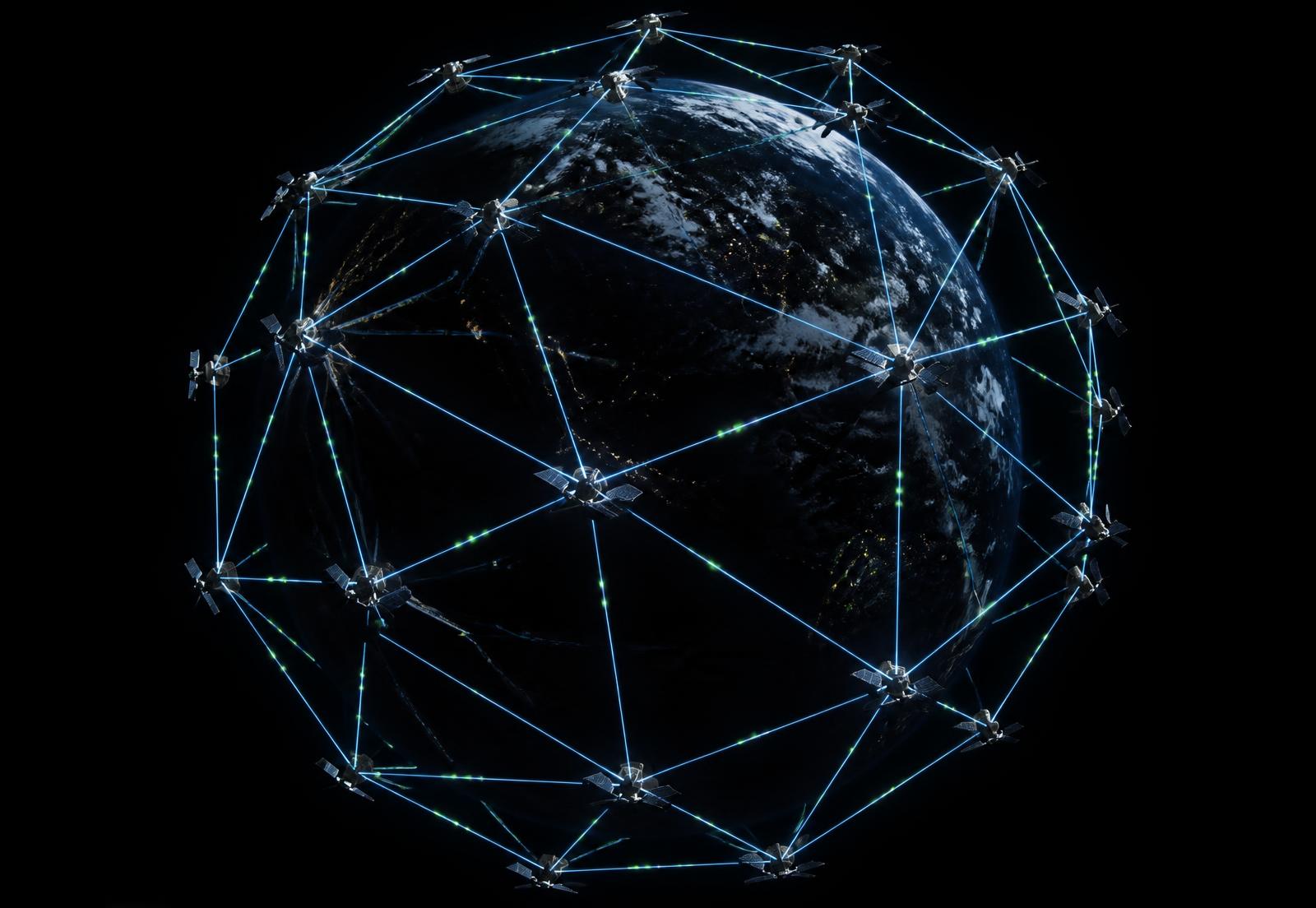
Why this is worth building
The market moved to meet the mission.
~$9T
Stablecoin payment volume in 2025
A settlement layer that no longer needs to be argued for, only connected to.
[8]~3B
Subscribers under direct-to-device agreements
Coverage contracted by a single operator across 50+ mobile networks.
[2]
What we are not pretending
The hard parts, stated plainly.
Orbital compute is at single-processor demonstration stage, not racks. These are the constraints any credible version of this plan has to answer.
Heat
There is no convection in vacuum. Every watt of compute must be radiated away, which caps density and drives radiator mass.
Radiation
Cumulative ionising dose degrades processors. Redundancy, shielding and scheduled replacement are design requirements, not options.
Debris and congestion
Adding satellites adds collision risk. Equatorial operations, responsible disposal and conjunction screening are part of the licence to operate.
Regulation and spectrum
Direct-to-device and stablecoin settlement both cross borders. Spectrum rights and divergent frameworks — the GENIUS Act and MiCA differ — shape rollout order market by market.
Sources
Everything above traces back to a public document.
- [1]World Economic Forum & McKinsey, Space: The $1.8 Trillion Opportunity for Global Economic Growth (April 2024)
- [2]AST SpaceMobile / Verizon definitive commercial agreement and MNO coverage (October 2025)
- [3]Google Research, Project Suncatcher: solar-powered TPU satellite constellations (4 November 2025)
- [4]Starcloud runs an NVIDIA H100 and Google's Gemma model in orbit (CNBC, December 2025)
- [5]Axiom Space Orbital Data Center nodes, first flights with Kepler Communications (2025)
- [6]ESA, Φsat-2: on-board AI processing of Earth observation imagery enters operations (July 2025)
- [7]GENIUS Act, Public Law 119-27 — US federal framework for payment stablecoins (signed 18 July 2025)
- [8]a16z crypto, State of Crypto: stablecoin payment volume reached ~$9 trillion in 2025
- [9]MOSIP, Journey Towards a Billion IDs (2025): 26 countries, 130 million IDs issued
- [10]World Bank ID4D Global Dataset — people without official proof of identity
- [11]NHESS, Satellite-based data for agricultural index insurance: a systematic review (February 2025)
- [12]SpaceX Rideshare pricing ($7,000/kg beyond the 50 kg base) and reported Starship pricing of $600–900/kg
- [13]WFP HungerMap LIVE — satellite and multi-source real-time hunger monitoring (2026 relaunch)
Third-party programmes and companies referenced on this page are cited as evidence of market and technology readiness. Their mention does not imply a partnership with, or endorsement of, SovereignSky, SpaceFile or SuperFile. Everything described as planned is forward-looking and is not an offer of securities or tokens.
The next decade is built above the atmosphere.
Compute, identity and settlement, all moving off the ground.